
News
Delta Poly Otefe Hosts 27th ACCE International Conference, Awhefeada Calls for African Self-Reliance

By Johnson Oghenekome
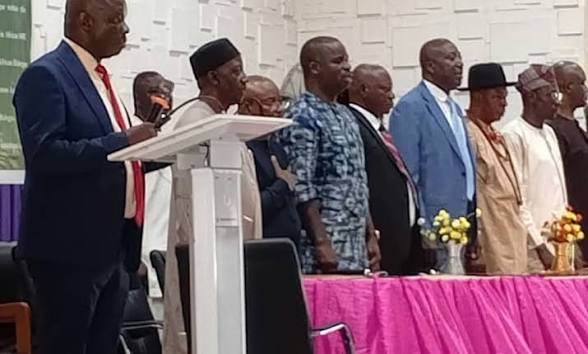
Delta State Polytechnic, Otefe-Oghara, has hosted the 27th International Conference of the African Council for Communication Education (ACCE), bringing together leading communication scholars, academics, media professionals and researchers from across Africa to examine the role of communication in shaping the continent’s political future and development.
The four-day international conference, which commenced on November 10 and ends on November 13, 2026, is holding at the institution’s Chief James Onanefe-Ibori Auditorium under the theme, “Communication, Politics and Intra-African Dialogue.”
A major highlight of the conference was the keynote address delivered by the Vice-Chancellor of Southern Delta University, Ozoro, Professor Sunny Ijirhevwe Awhefeada, who challenged African leaders and intellectuals to move beyond political independence and pursue genuine economic, technological and intellectual self-reliance.
Awhefeada challenges Africa on self-reliance
Speaking on the topic, “Intra-African Dialogue: The Role of Communication in Pan-Africanism,” Awhefeada maintained that Africa’s development aspirations would remain difficult to achieve if countries on the continent continued to depend excessively on foreign ideas, policies and solutions to address their challenges.
He called for increased investment in indigenous knowledge production, local research and home-grown policy frameworks capable of reflecting Africa’s historical experiences, cultural identities and developmental priorities.
Tracing the historical contributions of the media to Africa’s liberation struggles, the keynote speaker highlighted the roles of prominent nationalists and journalists, including Dr Nnamdi Azikiwe, Kwame Nkrumah and Chief Obafemi Awolowo.
He explained that newspapers and other media institutions played significant roles in political mobilisation, resistance against colonial domination and the promotion of nationalist consciousness.
Awhefeada also examined the Nigerian press’s contribution during the military era, acknowledging the sacrifices made by journalists and media organisations such as The Guardian, Concord, Newswatch, Tell and The Punch in demanding accountability from successive governments.
He recalled the dangers confronting journalists under military rule, including the 1986 parcel-bomb killing of Dele Giwa and other incidents of intimidation and attacks against media practitioners.
Against the backdrop of the rapidly changing digital communication landscape, he urged African media professionals to deploy emerging technologies in preserving indigenous languages, cultural heritage and historical records while challenging misleading narratives about the continent.
He emphasised that the media must continue to serve as society’s watchdog, promoting accountability, African unity, local production, self-reliance and the responsible utilisation of the continent’s abundant resources.
Rector celebrates Delta Poly’s international recognition
In his welcome address, the Rector of Delta State Polytechnic and Chief Host, Professor Emmanuel Ufuophu-Biri, described the hosting of the international conference as a significant milestone for the institution, Oghara community and Delta State.
He reaffirmed the polytechnic’s commitment to academic excellence, research development and the advancement of communication education.
The Rector also acknowledged the support of the Delta State Government, local government authorities, the host community and other stakeholders in making the conference possible.
Ufuophu-Biri, who disclosed that he became an ACCE member in 2003, recalled the institution’s previous engagements with the association, describing the conference as an opportunity to strengthen academic relationships, encourage research collaboration and enhance the polytechnic’s international visibility.
Oborevwori highlights education investments, cautions against misinformation
The Delta State Governor, Rt. Hon. Sheriff Francis Orohwedor Oborevwori, represented by the Commissioner for Higher Education, Professor Nyerhovwo Johnbull Tonukari, underscored the importance of responsible communication in promoting good governance, democratic accountability and peaceful coexistence.
The governor cautioned against misinformation, hate speech and divisive political narratives, warning that irresponsible communication could undermine public confidence, weaken democratic institutions and intensify social tensions.
He urged communication scholars and media practitioners to prioritise truthful, inclusive and development-oriented reporting capable of strengthening relationships between government and citizens.
Highlighting his administration’s interventions in the education sector, Oborevwori disclosed that contracts had been awarded for the construction of two hostel facilities in each of Delta State’s nine government-owned tertiary institutions.
According to him, each hostel facility is expected to accommodate approximately 500 students.
He also identified regular salary payments, improved staff welfare and infrastructural development as key priorities of his administration.
The governor further called on students and media practitioners to intensify awareness campaigns on the Nigerian Education Loan Fund (NELFUND), which provides eligible students with financial assistance towards their educational expenses.
Scholars examine Africa’s digital political narratives
The conference featured academic presentations, syndicate discussions and intellectual engagements covering contemporary issues in journalism, political communication, broadcasting, digital media and African development.
One of the scholarly contributions was a paper titled “Transnational Narrative Contestations and Political Image Management in African Digital Public Spheres,” jointly presented by Dr James A. Ashiekpe and Dr Swabra U. Yahya.
The paper examined competing narratives about Africa within digital communication spaces and their implications for political perception, reputation management and the continent’s representation in the international public sphere.
Discussions at the conference also explored the growing influence of digital platforms on political discourse and the responsibility of African communication professionals to ensure that the continent’s stories are communicated accurately, with appropriate context and cultural sensitivity.
Traditional rulers, dignitaries grace international conference
Beyond the academic sessions, the conference featured the recognition of outstanding scholarly contributions and the presentation of awards to deserving participants.
Lecturers, Heads of Departments and Deans who had attained significant academic and professional milestones were also honoured.
The gathering provided opportunities for networking, professional collaboration and the exchange of research findings among participants from diverse academic and professional backgrounds.
Traditional rulers and other prominent stakeholders were also in attendance, including the Ovie of Idjerhe Kingdom, His Majesty King Monday Obukohwo Whiskey, Udurhie I, and representatives of the Ovie of Oghara Kingdom, HRM Orefe III, Uku Oghara Na Me.
The Chairman of the Governing Council of Delta State Polytechnic, Chief Andrew Orugbo, was also among the dignitaries present.
ACCE’s 50-year contribution to communication education
Established in 1976 with the support of the United Nations Educational, Scientific and Cultural Organization (UNESCO), the African Council for Communication Education has played a role in promoting communication education, research, professional training and collaboration among communication educators across the continent.
Its establishment reflected the need to develop communication education and research frameworks that respond to Africa’s distinctive social, cultural, political and developmental realities.
The choice of “Communication, Politics and Intra-African Dialogue” as the theme of the 27th conference underscores the continuing importance of communication in addressing historical divisions, strengthening regional relationships and advancing a common continental development agenda.
As the conference draws towards its conclusion on Friday, November 13, participants are expected to consolidate their deliberations into a communiqué outlining key recommendations and resolutions before the closing ceremony.
The international gathering marks another opportunity for African communication scholars and media practitioners to reaffirm their responsibility in shaping public discourse, promoting accountability and advancing a continent where dialogue, intellectual independence and cooperation remain central to sustainable development.