
Politics
Oghara Born Journalist Shares Personal Encounter with Gov. Uduaghan

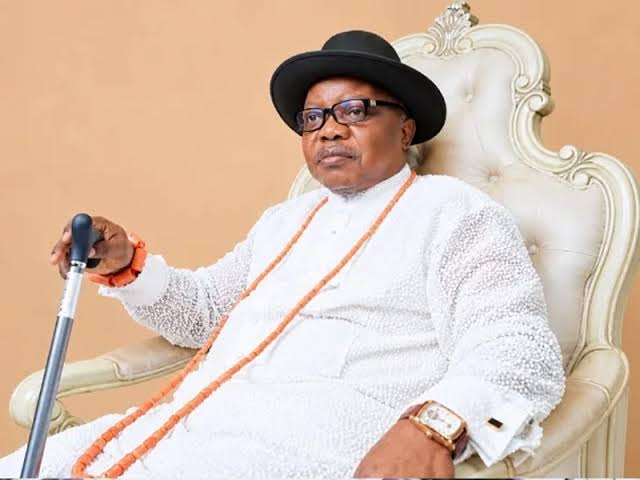
Death is an inevitable destination for every mortal, but the memories we leave behind determine how long we continue to live in the hearts of those we encounter. For former Delta State Governor, Dr Emmanuel Ewetan Uduaghan, death has come, but the memories of his life, leadership, private conversations and personal kindness will remain with me for a long time.
As I received the news of his demise on Monday, October 19, 2026, my thoughts travelled back to the days when our relationship was anything but cordial. I remembered the disagreements, the criticisms, the private conversations and, eventually, the friendship that developed between a former governor and a journalist who was never afraid to express his views.
Today, I can say without hesitation that Dr Emmanuel Ewetan Uduaghan was a good man who had his flaws, like every other mortal, but possessed the humility to reflect on his decisions and the generosity to maintain personal relationships.
From Criticism to Friendship
There was a time I openly criticised Uduaghan over his decision to ban Oghara youth activities. I disagreed with the decision and did not hide my position. As far as I was concerned, banning youth activities was not the best way to address the issues surrounding their conduct.
However, the story of our relationship took a different turn towards the twilight of his administration.
On a fateful afternoon, I received a telephone call from His Excellency. To my surprise, he invited me to a one-on-one meeting at his Warri residence, around the popular Otres Restaurant.
It was an invitation I could hardly have anticipated, considering my public criticism of his administration’s decision on Oghara youths.
I honoured the invitation, and that meeting became a defining moment in my understanding of the man behind the office.
During our conversation, Uduaghan explained the circumstances that led to the ban. He spoke about those who advised him to take the decision and, remarkably, admitted that he later regretted it. That admission meant something to me.
It is one thing for a political leader to defend every decision taken while in office, but quite another to acknowledge that some decisions may have been wrong. In that private conversation, I saw a side of Uduaghan that the public might not ordinarily have encountered.
He also recounted how he invited Oghara stakeholders to a meeting in Asaba, where an understanding was reached. The stakeholders, however, insisted that the activities of the youths should be regulated through workable rules and regulations to guide their conduct.
The objective was not necessarily to suppress the youths but to ensure that their activities operated within acceptable boundaries.
That conversation helped me understand the issues from a different perspective.
And before anyone asks me what transpired beyond the discussions, particularly the financial aspect of our encounter, let me make it clear: Don’t ask me how much he gave me, because I won’t tell you. Some experiences are best left as personal memories.
The Development of Oghara and a Governor’s Emotional Recollection
Beyond the controversy surrounding the youth ban, I was interested in another subject: the development of Oghara.
I asked Uduaghan about his administration’s contributions to the community, and his response was deeply emotional.
In his characteristically expressive voice, he spoke about the establishment of Delta State Polytechnic, Otefe-Oghara, the Delta State University Teaching Hospital (DELSUTH), Oghara, and the Oghara dual carriageway.
As he recounted the stories behind these projects, I listened with a different level of attention.
These were not merely government projects to him; they were part of the story of his administration and its connection with Oghara.
That conversation significantly increased my respect for him.
It did not mean that I suddenly agreed with every decision he had taken as governor. Rather, I came to appreciate that leadership, like human nature, is rarely one-dimensional.
A leader can make a decision one disagrees with and still make contributions worth acknowledging. Criticism and appreciation can coexist without contradiction. For me, that was one of the lessons of my relationship with Uduaghan.
The December Meeting and the Political Intrigues of 2014
Our next meeting took place in December of that same year at his residence on Olivia Agbajor Street.
That encounter opened another window into the political intrigues that shaped Delta State’s political landscape.
During our conversation, Uduaghan recounted events surrounding the Peoples Democratic Party’s governorship primaries between Senator Ifeanyi Okowa and the late Tony Obuh in 2014.
He narrated an episode in which, according to his account, he received a telephone call threatening that someone would take his life if he did not allow Okowa to win the primaries.
His response, as he told me, was that he could not allow anyone to take his life.
He further explained that he took the security chiefs attached to him to Government House. He presented this as part of the sequence of events surrounding the outcome of the primaries, which Okowa eventually won.
That was his account of a politically sensitive period in Delta State’s history.
Our conversations went beyond the publicly known political contest. He shared other intrigues and personal experiences that I have deliberately chosen not to disclose.
There are stories that can be told, and there are others that demand discretion. Not every private conversation must become public simply because one of the people involved has passed on.
Some confidences are better respected in death than betrayed for the sake of public attention.
I also remember the story he told me about former Accountant-General, Cyril Agbele, who has since become a very good friend of mine. Uduaghan recounted how Agbele allegedly disappeared and switched off his telephones to the twilight of his administration.
Those were fascinating conversations that offered me a glimpse into the complexities of political power, loyalty, fear, survival and personal relationships.
But I will not disclose everything he shared with me. There are matters I intend to take to the grave for obvious reasons.
A Christmas Tradition I Will Never Forget
Perhaps the most enduring evidence of the friendship that developed between us was the consistency with which he remembered me during the Christmas season.
From that December encounter until 2020, there was no Christmas, to the best of my recollection, that His Excellency Dr Emmanuel Ewetan Uduaghan would not send me something. It was a gesture I never took for granted.
In politics, relationships are often defined by immediate needs, calculations and expectations. People who once occupied prominent positions can discover, sometimes painfully, that many of those who surrounded them have moved on. Uduaghan, however, maintained that personal connection with me for years.
I was not his political associate in the conventional sense, nor did our friendship begin because I was always in agreement with him. In fact, it emerged from a period of disagreement and criticism.
That is why the relationship remains particularly meaningful to me. He could have chosen to regard me as one of those journalists who criticised his administration. Instead, he reached out, invited me for a conversation and gave me the opportunity to understand his perspective.
In doing so, he demonstrated that public criticism need not become permanent personal hostility. That is a lesson many public officeholders, journalists and political actors can learn from.
Uduaghan Tested Death and Bowed
The title of this tribute, Uduaghan Tested Death and Bowed, is a reflection on the ultimate encounter every human being must face.
A former governor, a medical doctor, a political leader, a husband, a father and a friend has taken his final bow.
The power of public office could not shield him from mortality. His accomplishments could not exempt him from the final journey. The friendships he nurtured could not keep death away. But death has not erased the memories he created.
For me, Uduaghan will remain the former governor who surprised me with a telephone call when I least expected it; the man who invited a critic to a private conversation; the leader who acknowledged regretting a decision; the politician who opened up about the intrigues of his time in office; and the friend who remembered me at Christmas for years.
I may not have agreed with every policy of his administration, and I will not pretend that our state had no challenges during his tenure. But in assessing the man, I cannot ignore the personal experiences that shaped my understanding of him.
His life reminds us that public figures should be judged not only by their controversies but also by their contributions, their willingness to reflect on their mistakes and the relationships they maintain beyond the corridors of power.
Uduaghan has departed, leaving behind a legacy that will continue to attract discussion, scrutiny and historical assessment. Yet, for those of us who encountered him beyond the public stage, there are private memories that no official biography can fully capture. Mine is one of such memories.
In all, Uduaghan was a good man. May the good deeds he performed on earth rent him an apartment in heaven.
May God comfort his family, the people of Delta State and all who mourn his departure.
Adieu, His Excellency, Dr Emmanuel Ewetan Uduaghan. You have taken your final bow, but the memories remain.
Kparobo Ehvwubare is a journalist, write from Oghara-Delta State. omeafrica3@gmail.com