
News
New tax law ‘ll drive more growth, accountability in Delta State – Oborevwori

By Marian Kogolo
As Nigeria prepares to implement its new tax regime from January 1, 2026, Governor of Delta State, Rt. Hon. Sheriff Oborevwori, has described the reform as a major catalyst for economic growth, improved service delivery and stronger accountability in governance.
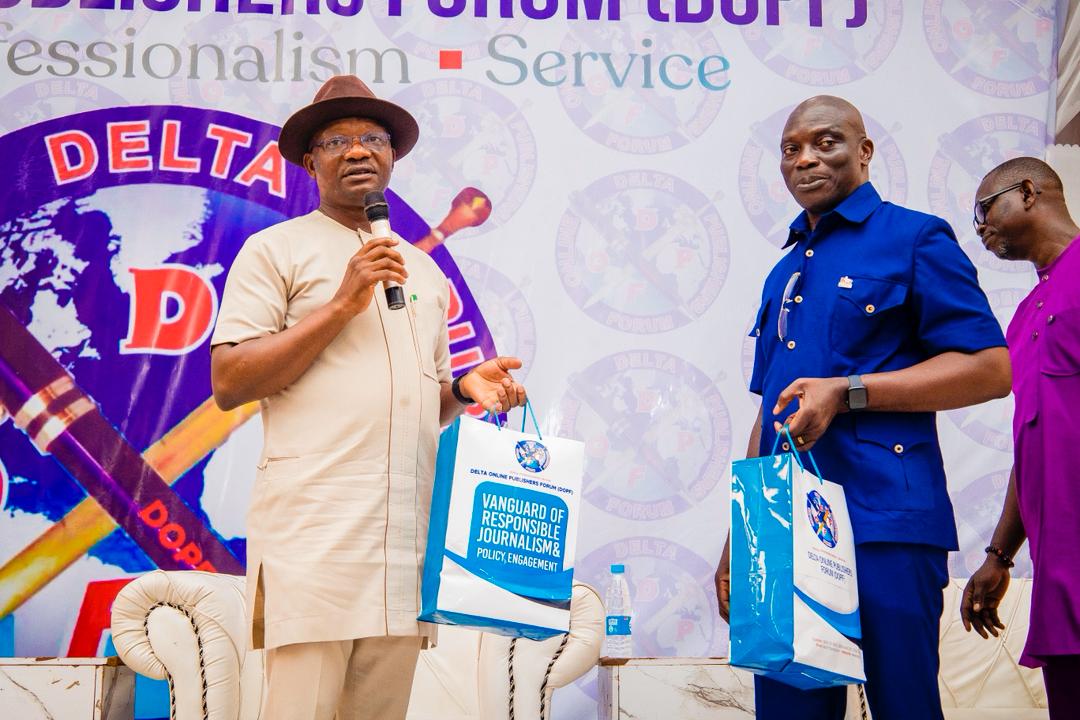
The Governor stated this while delivering a goodwill message at the 2025 Annual Lecture Series and Convention of the Delta Online Publishers Forum (DOPF), themed “Nigeria’s New Tax Law: Implications and Opportunities for Businesses and Society,” held in Asaba. He was represented by the Honourable Commissioner for Works (Rural Roads) and Public Information, Mr. Charles Aniagwu.
Oborevwori commended DOPF for its consistent commitment to knowledge-driven engagement, describing the forum as an important partner in civic education and nation-building.
“Knowledge is power, and when you make knowledge available, you distribute power to society,” the Governor said. “Unlike events that only entertain, this forum equips citizens with information that empowers decision-making in business and governance.”
He affirmed that the administration welcomed the tax reform, stressing that the success of any tax system depends not only on collection but on accountability and citizen engagement.
“When people pay tax, they naturally become interested in how their money is spent. This new law will strengthen public scrutiny and promote better governance because taxpayers will demand value for their money,” he noted.
Drawing examples from advanced economies, Oborevwori emphasised that taxation remains the backbone of sustainable development.
“In countries like the United States, personal and corporate taxes are the lifeline of the government. That is what funds infrastructure, social services and national security. It shows clearly that taxation is central to development,” he added.
He urged media professionals to take the lead in enlightening Nigerians on the provisions of the new law.
“By educating the public, especially business owners and workers, you are helping the nation to succeed. What you have done today deserves recognition and support,” he said, while also calling on the Presidential Committee on Fiscal Policy and Tax Reform to take note of DOPF’s proactive engagement.
Earlier in a welcome address, Chairman of DOPF, Mr. Emmanuel Enebeli, said the forum convened the lecture to foster informed dialogue on Nigeria’s fiscal future as the nation transits into a new era of tax reforms.
He stressed that taxation must translate into visible governance outcomes.
“The conversation today is not just about taxation. It is about what Nigerians expect in return; better roads, safer communities, and efficient service delivery that improves daily life,” Enebeli said.
He applauded the Delta State Government for the progress on the Ughelli–Kwale–Asaba Road, describing it as proof of purposeful leadership, while urging urgent intervention on federal routes including the Agbor–Asaba–Onitsha Road and the Agbor–Obiaruku–Abraka–Eku–Sapele Road.
On security, the DOPF Chairman commended the Governor for establishing the Delta State Security Trust Fund and appealed for speedy implementation of the recently passed Community Security Bill.
Delivering the keynote lecture, Associate Professor of Accounting at Dennis Osadebay University, Dr. Ochuko Emudainohwo, explained the new tax framework, stating that four major Acts would come into effect in 2026, including the Nigeria Tax Act, Nigeria Tax Administration Act, Nigeria Revenue Service Act and the Joint Revenue Board Act.
He listed the objectives of the reform as revenue diversification, reduction of overreliance on oil, expansion of the tax net, and modernization of tax administration.
“Nigeria’s tax-to-GDP ratio remains among the lowest in Africa. The new law seeks to correct this imbalance while protecting businesses and strengthening the economy,” he explained.
Emudainohwo highlighted key changes in corporate income tax, capital allowances, incentives, VAT, minimum tax requirements, and digital compliance, noting that while enforcement would be stricter, opportunities such as R&D tax credits and export incentives would boost business growth.
“The law introduces responsibility but also tremendous opportunities. If businesses adapt and government demonstrates transparency, the tax system can become a powerful tool for national prosperity,” he said.
A panel session moderated by Mr. Lawrence Okpewho, with Mr. Victor Origho, Barrister Ikpesu Jade and Barrister Martins Onyem Aghaobodo as discussants, further demystified the law for participants, linking taxation to accountability, infrastructure development and public trust.
The 2025 DOPF lecture ended with renewed calls for collaboration among government, the media and the private sector to ensure successful implementation of the tax reform and sustainable development across the country.